Fine particle testing: why and how?
Press - 12/07/2021

Search
Change language
CloseFine particle testing: why and how?

The French equipment manufacturer Capelec, which has just acquired the nanoparticle measurement specialist PEGASOR OY, is determined to position itself ahead of current regulations and thus gain a head start in the fine particle monitoring market. The company’s CEO, Thierry Coton, points out here that this type of monitoring was indeed mentioned in the Energy Transition Act.
CTM: You have recently acquired the Finnish company PEGASOR OY. As we noted in our last issue, this company specialises in the measurement of nanoparticles, more commonly known as ‘fine particles’. It aims to strengthen its leadership in the field of pollution monitoring equipment, including that used in vehicle inspection.
Thierry Coton: With nanoparticles, we are dealing with a new type of measurement which, initially, concerns diesel engines and aims to monitor the number of fine particles that are invisible. At present, vehicle inspection, through opacity testing, only measures visible particles, without detecting the invisible particles that are also emitted. The latter are the most dangerous to health, but detecting and counting them is more complicated because they are very small, hence the terms ‘fine’ or ‘nanoparticles’.
CTM: Diesel vehicles are now fitted with particulate filters, which should significantly reduce these emissions, shouldn’t they?
Thierry Coton: These filters are very effective at trapping these emissions, whether large or small; the problem is that, over time, these filters age and become less and less effective, particularly when it comes to the finest particles.
CTM: What is the average period during which a particulate filter remains fully effective?
Thierry Coton: In terms of lifespan, it is difficult to give a precise answer; the problem today is that garages and technical inspection centres do not have the measuring equipment that would allow them to determine the level of efficiency of a particulate filter. That is why, in collaboration with PEGASOR OY, we have developed this measuring device, which can identify a decline in a particulate filter’s capacity.
CTM: Are there any European standards that set maximum emission limits?
Thierry Coton: Studies have been carried out at European level and thresholds have been set. A particulate filter is considered to no longer have the required efficiency once the emission threshold exceeds 250,000 particles per cubic centimetre. A second threshold of 1,000,000 applies to vehicles whose particulate filter is faulty or has been removed.
CTM: Have other studies reached the same conclusions?
Thierry Coton: Measurements were carried out in Belgium on vehicles on the road; the results show that 5 per cent of the vehicles tested did indeed have values exceeding 1,000,000.
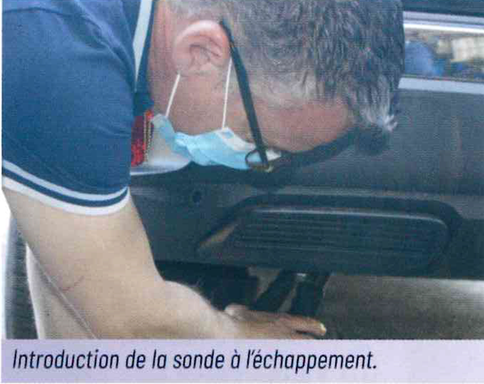


CTM: In France, testing for fine particulate matter is not included in the list of items checked during a vehicle inspection. Is the situation any different within the EU?
Thierry Coton: In Belgium, this test will be introduced from July 2022. A transition period is planned to send the most polluting vehicles for repair, before subsequently applying the 250,000 threshold; however, each country has its own variations on the transition phase.
The rest of the article is available in the July issue of CT MAGAZINE
Back to top